TL;DR:
For most West Palm Beach homes, an 11.25x23.25x2 MERV 13 filter is the right upgrade for smoke season. It meets the filtration level the EPA recommends during smoky periods. How well your system handles it depends mainly on how much filter area you have, and the two-minute check below shows where your home stands.
Is an 11.25x23.25x2 MERV 13 Filter Good for Wildfire Smoke?
Yes. A MERV 13 filter has to capture at least 50% of particles between 0.3 and 1.0 microns, the size range of fine smoke, while MERV 8 filters aren't tested in that range at all. That gap is the reason the EPA recommends MERV 13, or the highest rating your system can handle, during smoke events (EPA).
Key Takeaways
• MERV 13 is the filtration level the EPA recommends for smoke.
• Filterbuy's 11.25x23.25x2 filter actually measures 11.25 x 23.25 x 1.75 inches, which gives one filter roughly 1.8 square feet of face area. That's enough by itself for a system moving around 400 CFM, or about 1 ton.
• If you have a larger system, count your returns before you upgrade.
• Smoke loads filters quickly, so check yours every two to four weeks during burn season.
• MERV 13 traps smoke particles but won't remove smoke odor.
Why Does Smoke Matter in West Palm Beach?
West Palm Beach homes see smoke from three directions: sugarcane burning from October through April, drifting wildfire smoke, and dry-season brush fires. Because burn season alone lasts roughly seven months, a smoke-ready filter matters here for much of the year.
Agricultural burning. Western Palm Beach County burns sugarcane fields before harvest from October through April (WLRN). A Florida State University study linked the fine particles from these fires to health risks across South Florida, although the same researchers note the region still meets federal air standards (FSU News).
Distant wildfires. In fall 2023, smoke from Canadian wildfires drifted over southern Florida, and the county health department issued an alert (WUSF).
Dry-season brush and Everglades fires. These can push haze toward the coast with little warning.
Plan your filter supply for the whole season rather than month by month.
How Does an 11.25x23.25x2 Smoke Filter Capture Smoke?
As return air passes through, the dense pleated media in a MERV 13 filter traps fine particles. The EPA's MERV guide sets three minimums for this rating:
• At least 50% of particles 0.3–1.0 microns (fine smoke)
• At least 85% of particles 1.0–3.0 microns
• At least 90% of particles 3.0–10 microns
Those numbers only apply to air that actually moves through the filter. Your fan setting matters almost as much as the filter itself.
Will MERV 13 Restrict Airflow in a 2-Inch Filter?
Usually not, as long as the filter is clean and your system has enough filter area. A 2-inch filter packs more pleated media into the same opening than a 1-inch filter, so air moves through it more slowly and meets less resistance.
Instead of asking which MERV rating to buy, we start by asking how fast air is hitting the filter. Building-science guidance calls for roughly 2 square feet of filter for every 400 CFM of airflow, with air speed across the filter kept under roughly 250 feet per minute (Green Building Advisor).
You can run this check yourself in a couple of minutes:
1. Find your system's tonnage on the outdoor unit's data plate. Model numbers often include 18, 24, 30, 36, 48, or 60, which refers to thousands of BTUs per hour. Divide by 12 to get tons, so 36 means a 3-ton system.
2. Count how many 11.25x23.25 filters your system uses.
3. Compare your tonnage to the air speed through a single filter:
1 ton (400 CFM): roughly 220 feet per minute, within the guideline
1.5 tons (600 CFM): roughly 330 feet per minute, above the guideline, so test before relying on MERV 13
2 tons (800 CFM): roughly 440 feet per minute, high
3 tons (1,200 CFM): roughly 660 feet per minute, too high for MERV 13 without a pressure test
With two filters of this size, those speeds drop by half.
If your home lands above the guideline, you still have good options:
• Switch ratings with the season. Run MERV 11 day to day and move up to MERV 13 when smoke arrives. Filterbuy makes the 11.25x23.25x2 in MERV 8, 11, and 13, so you can change ratings without changing sizes. Swap out the MERV 13 at the first sign of graying.
• Add filter area. A technician can install a second return or a larger filter grille.
• Upgrade to a media cabinet. A 4- or 5-inch cabinet gives the same system far more filter area.
Whichever range you're in, watch for weak airflow at the registers, a whistling return, a filter bowing inward, or longer run times. Ice on the refrigerant lines is the most serious sign. If a fresh filter doesn't solve the problem, call a technician and make sure your indoor coil is clean.
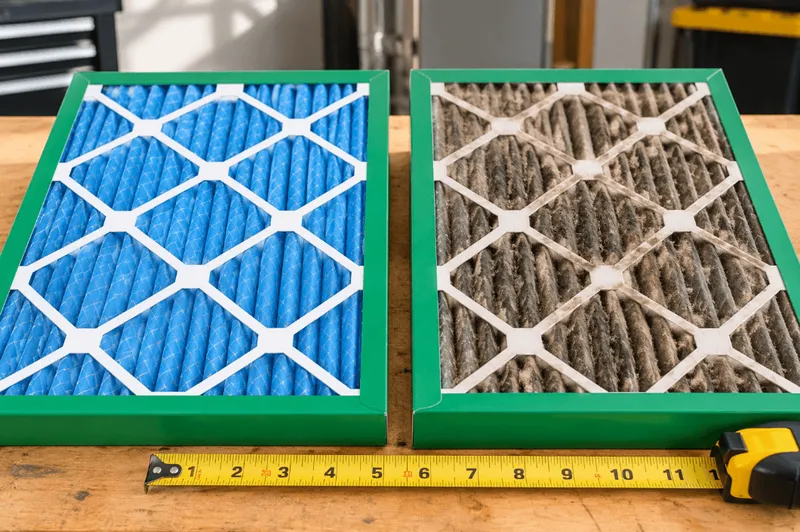
What Is MERV 13 2-Inch Filter Static Pressure, and Should I Test It?
Static pressure is the resistance your blower works against, measured in inches of water column (in. w.c.). Design guidance typically allows around 0.10 in. w.c. for a basic 1-inch filter, while contractors often measure closer to 0.25 across MERV 13 filters. A well-sized 2-inch MERV 13 has tested below 0.03, which shows how much filter area matters.
To test it, a technician reads the pressure on both sides of the filter with a manometer, then compares the system total to the limit on the air handler's data plate. We recommend the test for any home that lands above the guideline.
How Should I Use an 11.25x23.25x2 Filter for Smoke Season?
Install the filter before burn season, run the fan on "On" only while smoke is present, and check the filter every two to four weeks. The steps below cover each part.
1. Measure first. Filterbuy lists the 11.25x23.25x2's actual size as 11.25 x 23.25 x 1.75 inches, so compare that to your slot. Our guide on why nominal and actual filter sizes differ explains the gap.
2. Check the seal. With the system off, look along all four edges. If you can see daylight, smoke can slip past too.
3. Install it in early October, before burn season begins, with the arrow pointing toward the blower.
4. Set the fan to "On" when smoke arrives. The EPA advises running it as often as you can with a high-efficiency filter.
5. Switch back to "Auto" once the air clears. Most guides skip this step. In our humid climate, a fan that never stops can pull moisture off the coil and back into the house.
6. Watch the forecast on the AirNow Fire and Smoke Map, and close windows and fresh-air intakes on smoky days.
7. Check the filter every two to four weeks through burn season. For the rest of the year, our West Palm Beach filter-change guide covers the timing.
Where Can I Get an 11.25x23.25x2 High Efficiency Filter?
This size is hard to find in stores, so we usually point homeowners online. Filterbuy, a family-owned U.S. air filter company that has sold filters since 2013 and manufactures them in Alabama, Florida, Pennsylvania, and Utah, sells 600+ sizes direct to consumers, including this one. According to Filterbuy's product page, the Filterbuy 11.25x23.25x2 filter comes in MERV 8, 11, and 13, measures 11.25 x 23.25 x 1.75 inches, and is made in the USA.
Compare Filterbuy's 11.25x23.25x2 filter options and choose MERV 13 if your system passed the check above. We also suggest keeping two spares on hand from October through April, so you won't be waiting on shipping when smoke rolls in.
“Most smoke-season calls we get trace back to a filter that couldn’t keep up, or a fan that wasn’t running long enough to use it,”
Essential Resources on “11.25x23.25x2 Air Filters”: 7 Trusted Guides to Choose, Fit, and Maintain Yours
1. Find Your Exact Size and Choose the Right MERV Rating
Filterbuy's product page lists the actual size of this filter along with its MERV 8, 11, and 13 versions.
Source: Filterbuy · https://filterbuy.com/air-filters/11-25x23-25x2/
2. Learn What a Home HVAC Filter Can and Can't Do
The EPA explains how central filters work and when a portable air cleaner is worth adding.
Source: U.S. EPA · https://www.epa.gov/indoor-air-quality-iaq/air-cleaners-and-air-filters-home
3. Make Sure MERV 13 Won't Choke Your Airflow
This guide shows how enough filter area keeps resistance low, even at MERV 13.
Source: Green Building Advisor · https://www.greenbuildingadvisor.com/article/supply-air-filtration-and-airflow-pressure
4. Know When Smoke Is Heading Your Way
AirNow tracks fine particle pollution from fires in near real time, so you know when to close up the house.
Source: AirNow (EPA and U.S. Forest Service) · https://fire.airnow.gov/
5. Run Your Filter the Right Way During Smoke
The EPA walks through filter fit, continuous fan use, and when to change a dirty filter.
Source: U.S. EPA · https://www.epa.gov/wildfires/indoor-air-filtration
6. Give Vulnerable Family Members a Cleaner-Air Room
The EPA shows how to seal and filter a single room for anyone sensitive to smoke.
Source: U.S. EPA · https://www.epa.gov/emergencies-iaq/create-clean-room-protect-indoor-air-quality-during-wildfire
7. Set a Filter-Check Routine
ENERGY STAR recommends checking your filter monthly and replacing it at least every three months.
Source: ENERGY STAR · https://www.energystar.gov/saveathome/heating-cooling
Supporting Statistics
1. MERV 13 Plus a Continuous Fan Cuts Indoor Smoke Particles Roughly in Half
According to the EPA, a high-efficiency filter may lower indoor PM2.5 by around 50% when the fan runs nonstop. Even a low-efficiency filter may cut it by around 24%.
Source: U.S. EPA · https://www.epa.gov/wildfire-smoke-course/strategies-reduce-exposure-indoors
2. 90% of Florida Homes Use Central Air
Ninety-six percent of Florida households use air conditioning, and 90% use a central unit. In most homes here, the return filter cleans nearly all the air you breathe indoors.
Source: U.S. Energy Information Administration · https://www.eia.gov/pressroom/releases/press510.php
3. MERV 13 Captures at Least Half of the Smallest Smoke-Sized Particles
A MERV 13 filter must capture at least 50% of particles from 0.3 to 1.0 microns. MERV 8 isn't tested in that range.
Source: U.S. EPA · https://www.epa.gov/indoor-air-quality-iaq/what-merv-rating
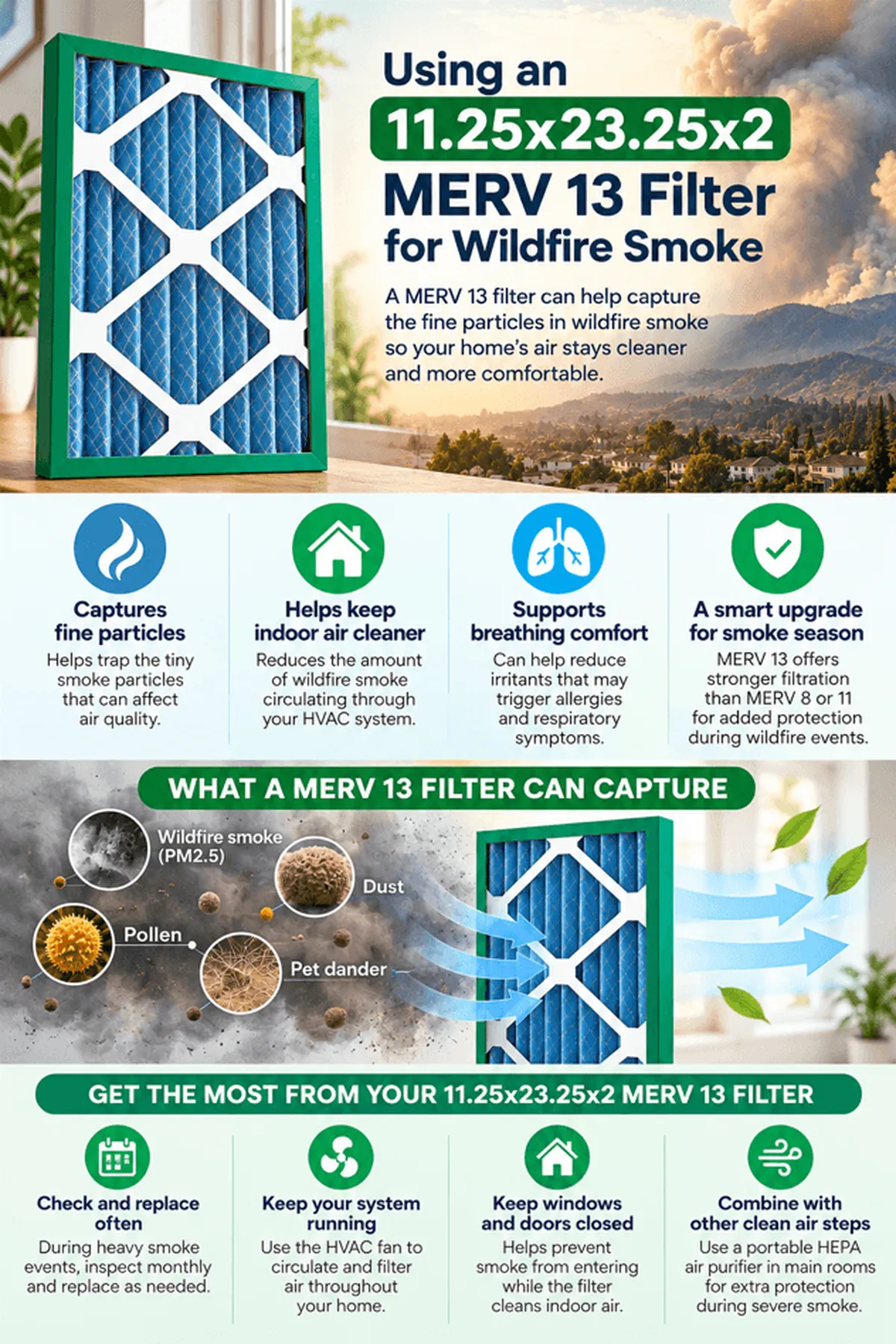
Frequently Asked Questions
Is MERV 13 better than MERV 11 for smoke?
Yes. In the 0.3–1.0 micron range, MERV 11 must capture at least 20% of particles, while MERV 13 must capture at least 50%.
Is MERV 13 as effective as a HEPA filter?
No. A HEPA filter captures at least 99.97% of 0.3-micron particles, but most home HVAC systems aren't built for one. For extra protection, run MERV 13 in your system and add a portable HEPA air cleaner in bedrooms.
Will a MERV 13 filter remove smoke smell?
No. It captures particles, not gases, so odor calls for activated carbon. Filterbuy also makes activated carbon filters, so check whether one comes in your size.
How often should I change it during burn season?
Check it every two to four weeks and replace it once it looks gray or smells of smoke.
Will an 11.25x23.25x2 filter fit a 1-inch slot?
No. A 2-inch filter is about 1.75 inches deep and needs a 2-inch rack. If your slot is 1 inch, buy the matching 1-inch size instead, since a filter that doesn't fit snugly lets air slip around it.


