TL;DR
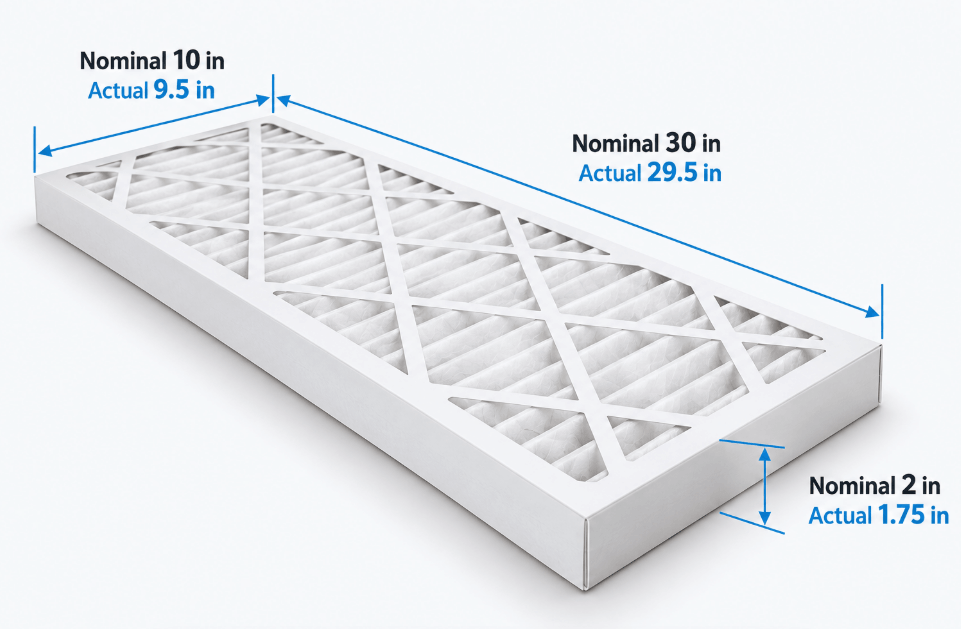
10x30x2 is a nominal size, a rounded label rather than an exact measurement. Many 10x30x2 filters measure about 9.5 x 29.5 x 1.75 inches, and some brands make them 9.75 x 29.75 x 1.75. The smaller size is deliberate, so the filter slides into its slot without bending. If yours is labeled 10x30x2, it's the right filter even though the tape measure says otherwise.
If your 10x30x2 filter measured short, nobody made a mistake. The label describes the opening the filter is built for, and manufacturers trim each side so the frame slides in without being forced.
In my experience working on homes around West Palm Beach, the undercut is rarely what causes trouble. Problems usually start when a homeowner switches brands and never checks whether the new frame seals.
“The number on the frame tells you which slot a filter was built for. Only a tape measure tells you whether it seals,” says Kristien de Bruijn.
Key Takeaways
• A 10x30x2 filter's nominal size is the name you shop by. Its actual size is what it measures.
• Most 2-inch filters are about 1.75 inches deep.
• The undercut varies by brand, from 0.25 to 0.5 inches per side, so two “10x30x2” filters can differ slightly.
• Filterbuy, a U.S. air filter manufacturer, lists its 10x30x2 filter's actual size as 9.5 x 29.5 x 1.75 inches.
• Fit problems are most likely after a brand switch, so measure your rack or old filter before you change brands.
What Is the Difference Between Nominal and Actual Air Filter Size?
Nominal size is the rounded, whole-inch number printed on the frame and used to shop. Actual size is the filter's true edge-to-edge measurement. For 1-inch and 2-inch filters, the actual size is usually slightly smaller, because a 10x30x2 is built to fit a 10 x 30 opening rather than to measure 10 x 30 itself.
Is a 10x30x2 Filter Really 9.5 x 29.5 Inches?
For many brands, yes. Filterbuy's 10x30x2 air filter listing gives the actual size as 9.5 x 29.5 x 1.75 inches, a half-inch undercut on length and width and a quarter-inch undercut on depth. Other brands take a quarter inch off every side, producing a 9.75 x 29.75 x 1.75 filter. Both are sold as 10x30x2.
Frames often print these sizes as fractions:
• 9.5 x 29.5 x 1.75 is the same as 9-1/2 x 29-1/2 x 1-3/4
• 9.75 x 29.75 x 1.75 is the same as 9-3/4 x 29-3/4 x 1-3/4
Why Is My Air Filter Smaller Than the Label?
An air filter is smaller than its label because of the undercut, a small trim that lets it slide into the rack. A filter cut to exactly 10 x 30 would have to be jammed into a 10 x 30 slot, which can bow the frame or crush the pleats. The EPA advises choosing a filter that fits snugly enough to stop air leaking around it but never needs bending or crushing to go in.
Ease of fit matters in West Palm Beach, where I often find air handlers in tight garage closets or hot attics. A filter that slides in easily gets changed on schedule; one that fights you stays in too long.
Does the Difference Between 9.5 and 9.75 Inches Matter?
Usually not, but in a snug rack the quarter-inch difference between brands can matter. A 9.5 x 29.5 filter replacing a tight-fitting 9.75 x 29.75 may leave a gap on each side, and a 9.75-inch filter may bind in a rack sized for 9.5.
Gaps matter because air takes the easiest path, carrying unfiltered dust to your blower and evaporator coil regardless of MERV rating. Quality-control testing across more than 600 filter sizes shows that “gaps as small as 1/8 of an inch” can open bypass channels. So whenever a homeowner switches brands, I check that quarter-inch difference before the new filter goes in.
• Which 10x30x2 should you buy? Measure the inside of your filter rack, then match your situation:
• Rack is about 10 x 30 inches or roomier: Either undercut fits, so choose on MERV rating and price.
• Your old 9.75 x 29.75 filter fit snugly: Stay with a 9.75-inch undercut, or check for gaps if you switch.
• Your old 9.5 x 29.5 filter was already snug: Stay with a 9.5-inch undercut, such as 10x30x2.
• Neither size seals without gaps or bending: Your rack may be non-standard, and a custom filter built to your measurements is the fix.
How Do You Measure a 2-Inch Air Filter?
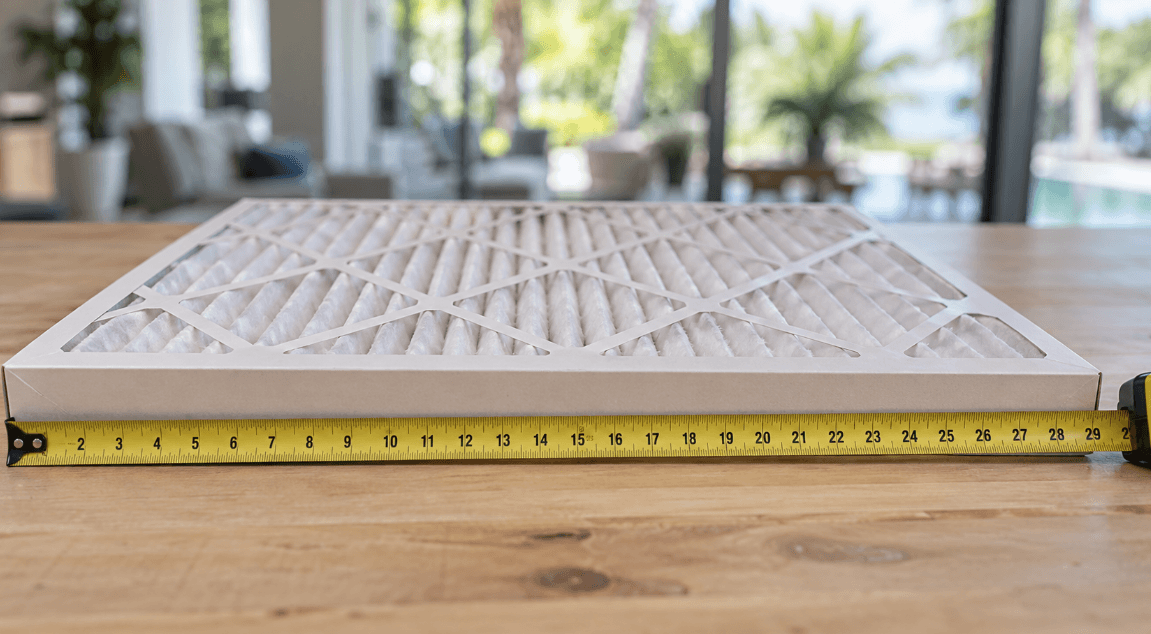
Measure the old filter to the nearest 1/8 inch, then round each number up to the next whole inch, so 9.5 x 29.5 x 1.75 becomes 10x30x2.
1. Turn off the HVAC system at the thermostat.
2. Slide out the old filter and check the edge of the frame for a printed size.
3. Measure length and width edge to edge, to the nearest 1/8 inch.
4. Measure the depth. A 2-inch filter reads about 1.75 inches.
5. Round each number up to the next whole inch to get the nominal size.
6. No old filter? Measure the inside of the slot and choose the nominal size whose actual dimensions fit within it.
The order of the numbers doesn't matter: 10x30x2 and 30x10x2 are the same filter.
What Measuring Mistakes Lead to the Wrong Filter?
Five measuring mistakes can send you to the wrong 10x30x2:
1. Measuring the grille instead of the rack. A return grille's outer trim is larger than the filter behind it.
2. Rounding down. A 9.5-inch reading rounds up to 10, never down to 9.
3. Measuring a bent filter. A filter that bowed in the rack can read short, so lay it flat or measure the rack.
4. Misreading depth. About 0.75 inch means a 1-inch filter, 1.75 means 2-inch, and 3.75 means 4-inch.
5. Installing it backward. The airflow arrow should point toward the air handler, away from the return grille.
Essential Resources on “10x30x2 Air Filters”
1. Confirm Your 10x30x2 Filter's Exact Size Before You Buy
10x30x2 air filter page lists the actual size of a nominal 10x30x2 as 9.5 x 29.5 x 1.75 inches and shows MERV 8, 11, and 13 options side by side.
Source: Filterbuy · https://filterbuy.com/air-filters/10x30x2/
2. Compare MERV Ratings on Evidence
The EPA's MERV rating overview shows which particle sizes each rating from MERV 1 to 16 captures, so you can compare MERV 8, 11, and 13 filters directly.
Source: U.S. Environmental Protection Agency · https://www.epa.gov/indoor-air-quality-iaq/what-merv-rating
3. Know What Your Filter Removes
The EPA's guide to sources of indoor particulate matter explains where indoor dust, pollen, pet dander, and smoke come from and when a higher-efficiency HVAC filter helps.
Source: U.S. Environmental Protection Agency · https://www.epa.gov/indoor-air-quality-iaq/sources-indoor-particulate-matter-pm
4. Set a Filter-Change Schedule
ENERGY STAR's Heat & Cool Efficiently guide recommends checking your filter monthly and changing it at least every three months, because a dirty filter slows airflow and wastes energy.
Source: ENERGY STAR · https://www.energystar.gov/saveathome/heating-cooling
Supporting Statistics
1. 96% of Florida households use air conditioning, and 90% use central AC, according to the U.S. Energy Information Administration's 2020 Residential Energy Consumption Survey. Central systems pull the home's return air through the filter before it reaches the equipment.
2. Replacing a dirty, clogged filter can lower an air conditioner's energy use by 5% to 15%, according to the U.S. Department of Energy. The DOE also notes that blocked airflow lets air bypass the filter and deposit dirt on the evaporator coil.
3. People spend about 90% of their time indoors, mostly at home, according to the EPA's Guide to Air Cleaners in the Home.
Final Thoughts
A 10x30x2 that measures 9.5 x 29.5 inches is working as designed. Treat the label as your starting point and the actual size as the deciding measurement. The moment that deserves attention is a brand switch, when a quarter-inch difference can turn a snug fit into a gap.
Next Steps
1. Measure your current filter or rack to the nearest 1/8 inch.
2. Compare it with the actual size in the product listing.
3. After installing, do the daylight test: with the system off, look along all four edges. Visible light or room for a finger means air is getting around the filter.
4. Write the actual size inside the filter door or on the air handler cabinet so your next order matches a real measurement.
5. Set a monthly reminder to check the filter.
Frequently Asked Questions
What is the actual size of a 10x30x2 air filter?
A 10x30x2 air filter usually measures about 9.5 x 29.5 x 1.75 inches (9-1/2 x 29-1/2 x 1-3/4), the actual size listed for the 10x30x2 for its 10x30x2. Some brands make it 9.75 x 29.75 x 1.75 inches.
Can I use a 1-inch filter, or two stacked 1-inch filters, in a 2-inch slot?
No. A single 1-inch filter can shift in a 2-inch rack and let air slip past. Two stacked 1-inch filters measure only about 1.5 inches together, so they still sit loose in a 1.75-inch rack, and the extra layer adds airflow resistance.
Can I trim a larger filter to fit?
No. Cutting breaks the frame that holds the pleats and seals the edges, creating the gaps you're trying to avoid. If no standard size fits, order a custom filter. Manufacturers such as Filterbuy make them.
How often should I change a 10x30x2 filter in South Florida?
Check it monthly, as the ENERGY STAR maintenance checklist recommends, and plan on changing it every 30 to 60 days. Many 2-inch filters are rated for up to three months, but with AC running nearly year-round, I treat three months as the upper limit. Our West Palm Beach filter-change guide covers local timing.
Which MERV rating should I choose for a 10x30x2?
MERV 8 handles everyday dust and lint, while higher ratings capture finer particles. The EPA suggests MERV 13 or as high as your system fan and filter slot can accommodate, so ask an HVAC technician if you're unsure. Our guide on choosing MERV 8 furnace filters compares the options.
Ready to Order the Right 10x30x2?
Measure your filter today and order the size that matches your actual measurement, not just the label. If no standard 10x30x2 seals your rack without gaps or bending, have a local HVAC technician check the rack before your next change, because a poor fit lets air skip the filtration you're paying for.
Glossary
• Nominal size: The rounded size printed on an air filter and used to shop, such as 10x30x2.
• Undercut: The amount trimmed from each nominal dimension so a filter fits without forcing, usually 0.25 to 0.5 inches.
• Air bypass: Unfiltered air flowing through gaps between the filter frame and the slot.
• MERV (Minimum Efficiency Reporting Value): A 1–16 rating, based on an ASHRAE test method, of how well a filter captures particles between 0.3 and 10 microns.
• Filterbuy: A U.S. air filter manufacturer based in Talladega, Alabama, that makes pleated HVAC filters in more than 600 sizes.
Learn more about HVAC Care from one of our HVAC solutions branches…
Filterbuy HVAC Solutions - West Palm Beach FL
1655 Palm Beach Lakes Blvd., Ste 1005 West Palm Beach, FL 33401
(561) 448-3760
https://maps.app.goo.gl/VarpgNZnxuPQuW8A7